Posts mit dem Label Practical werden angezeigt. Alle Posts anzeigen

Montag, 3. November 2008

Signs

Fishy protestIn my first days in Japan i really was surprised seing so many pannels, telling me what to do and what not. I recall someone telling me about a sign saying "stick to the rules". Of course there is no such sign, but that's the impression you get.
So i have been thinking about that. It's not that there are more or radically different things you are told to do/omit. So what's the fuzz about it?

Earhtquake warning...As you can see on this page, japanese signs tend to be manga style. They're funny and most imortant of all, these images are real eyecatchers. (Who cares for all the "strictly forbidden"blabla to be seen in western countries anyway). It's just like advertisement. By the way mangas are rooted in early stage publishing business, where one-sheeted graphic stories for the (low educated) masses preceeded modern newspapers. So the imagry is something to be understood by everyone.

Please drive slowly...Of course rules and social order is something very very important in this country. That doesn't only mean you have to "stick to the rules" but also that the authority is responsible to provide and ensutre them, to never leave the subject without guidance.

Emergency road...Moreover, the concept of a soul, in that special case the notion of a good and or bad conciousness rooted in christianism, is not that important. Moral is something rather practical. It's achildrens phrase "If noone sees it, it's ok".
So the omnipresence of signs is also intended to remind you of the social framework you're alway in, even if "noone sees"...

Mittwoch, 15. Oktober 2008

Commonly told untruths about Japan

Some months have passed now since i returned home and there wasn't much time to look back. But i won't leave this blog behind unfinished, so here we go:

Japan is expensive

Of course that depends of current exchange rates, but as said before in general things of every day life are rather cheap and you always get good value for what you pay.

Everyone is in martial arts
Most people like Baseball and Soccer has become rather popular for watching as well as playing it themselves. Of course people do practice martial arts, expecially young people consider it as something folkloric though and prefer western things.

The 18 something ways of separating your waste
Basically you have two main categories, which are “burnable” and “unburnable waste. Then there is cans together with bottles and if you have a lot of it: paper. Confusion starts when time enters the calculation. You have to put out different kinds of garbage at different days of the week. Furthermore you're supposed to put the garbage-bag outside no more than one or two hours before the garbage truck arrives in the morning (most people nevertheless do it on the evening before). Eventually that means you either dispose bags half empty or you end up storing them in your flat.
In a land where everything is meant to be practical, waste separation probably is a most unnecessarily complicated matter.

Subway intervals of 1-2 minutes and subway stuffing people into subway cars
Notorious Marunouchi-Line knows intervals of about 2 minutes for a period of 10 minutes at around 8 o'clock, the rest of the day and on practically every other line you have intervals of about 5min or more.
I never experienced the stuffing staff myself, not even early in the morning, but I got reports on it. What's common: the last two (usually guys) entering a full car step in turned around, pushing the crowd further into the compartment with their backs. Only those are definitely not paid for their “service”.

Tokyo is not Japan
Certainly it's different from the countryside, just like every large town is to the province. Only, regarding word largest town, you expect something like internationality... Wrong! There might be a lot of foreigners, but what about some hundred thousand in between 20 millions? And no one is speaking english!

Japanese can't say no
In fact to be polite, you have to avoid a direct negation. Nonetheless there is a word for no and it is used. You even can express dissent. But only to weaken a compliment received.

Mangas are read from right to left
In fact this is correct: Only that any printed matter is read from right to left, including books and newspapers. So mangas aren't something special.

Donnerstag, 7. Februar 2008

Cutting through the waves up north...

Once again a ferry ride and once more strong waves conveyed by wind from the north. I hoped to get some sleep during the journey, so i layed down at once after boarding at 6. Although luying flat on the matrass, i completly lost balance, only this time this was no alcohol induced waggeling, but rather the some 100m long vessel itself, lifted by the rough sea, giving me moments of levitation, then hitting the water surface again, So i opted for a rattan armchair in a windowed corridor (thanks for the hint dad), to spend my wake there. Going by ferry is not so popular anymore, as regular flights link even the remotest Okinawan islands with the rest of Japan and its not much more expensive taking the plane if you book early. Therefore one line going to the southern islands stopped passenger transport at all.

The ships of Arimura Line are part Cargo part passenger ferries (very common on all islands) and there is only one ferry a week back to Naha. There are several classes, the first, the regular one, with cabins for 6 people and a 2nd class-type with bunk beds equipped dorms, no sign of tatami dorms i read about on the internet. Although going by ferry might not be the most convenient way of travelling anymore, as it takes 14h from Ishigaki to Naha (around 450km) it's a good way to experience the distance between the islands and let you feel that you're actually in the middle of the sea, a fact the japanese seem to try to make you forget.

Despite an island country there is not much sense for the sea here (except fishing). In Honshu you'll never see anything of the sea, if you not really go for it and Tokyo is even worse in that regard (artificial Odaiba doesn't count!). On the other hand this isn't really surprising regarding the countries self chosen isolation, where it was forbidden to leave the country for several hundreds of years, neither were tall ships allowed to be build. So even today, the ocean seems to rather mark a definite border than something accessible.

Samstag, 19. Januar 2008

Ekimae

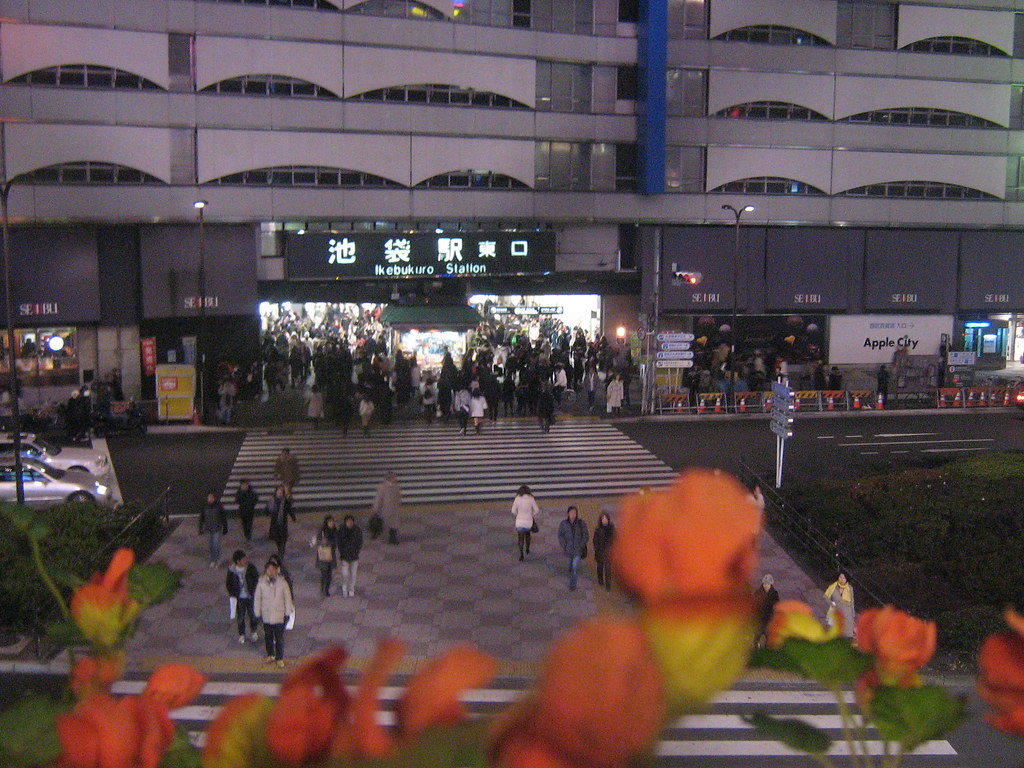
Ekimae means in front of the station. Other than in Europe, where train stations aren't really the place of your choice, in Japan with its public transport society, all revolves around it. So when you tell somebody where you live, you rather say the line and the station where you get off. And of course that's where you meet friends and colleagues or go shopping after work. So the bigger stations (Shinjuku and Ikebukuro being worlds largest) are at once giant department stores, where you can buy what latest fashion trends prescribe, there are floors filled up with restaurants, bars and so on. As the railway companies own the stations, they also usually own the stores (Odakyu in Shinjuku, Seibu in Ikebukuro, again one of Japans largest, and Lumine at major JR-stops).

As it is a meeting point it doesn't stop at the station itself, but the area around those are places to spend free time,
where even more shops, bars, game centers and of course red-light related businesses (Shinjuku's infamous Kabukichou) are nestled along, where neon signs or megaphone using staff crying up their services. So today stations picked up a role, filled out by temples and shrines in former times, this tie still being present in the name of the area around Harajuku station, named Omotesandou, literally meaning front way to a Shrine (in this case the Meiji-Jingu).

Also, the places you get to know as a tourist, like the above mentioned are those around the station. And European railway companies seem to try to inherit that concept, e.g. the new central station in Berlin, and the efforts (?) made by OEBB, to modernize their buildings.


Fotos

In the evening, there are often music performars of varied talent gathering around the station to promote their art. One particular good one i saw, was Re-Trick in Shinjuku:

Sonntag, 9. Dezember 2007

Melons for 60Euros each – Costs in Japan

I went to Japan somehow anxious about the high prices, i have heard of. Tokyo is said to have been worlds most espensive city up to 2005 now being the second to next.
But as soon as i got here I got more relaxed. Thanks to a strong Euro together with a weak Yen (different interest rates along with a weak dollar the Yen is tied to) the widespread horror stories are definitely outdated today (for Europeans at least...)

In fact there are some things that are really expensive here, especially in Tokyo:
  1. Housing (this applies definitely to Tokyo, this is also why so many people taking daily rides of 1h and more).
  2. Riding the Shinkansen (Taking the local trains or rapid ones is cheap, but as you have to get along with distances quite often, so you will want to get on a limited express or the said Shinkansen and a seat reservation there doubles resp. tripples the price).
  3. Fruits and vegetables: The melons are still expensive, and a single apple costs around laughable 1,5 Euros. But it is possible to get around that somehow. Tangerines (what a stupid word for Mandarinen!) and Banans are ok. Replace lettuce with soy sprouts and it is ok too.
But just like the mentioned points above, the real costs are not about about what you need, but what you can get.
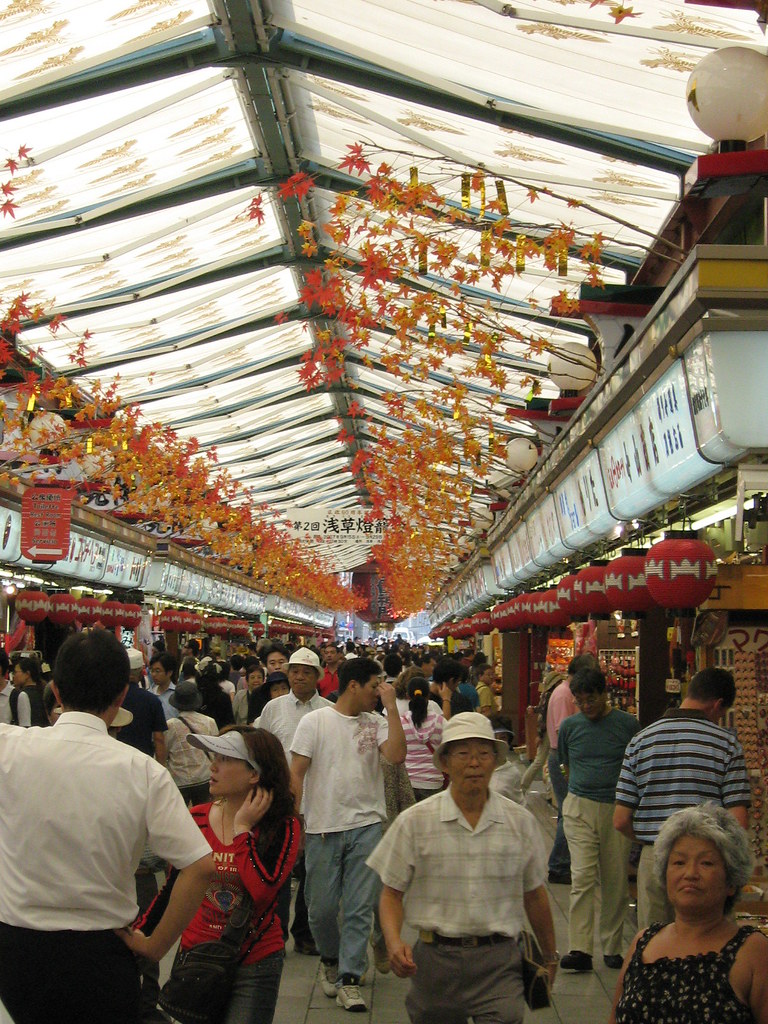
This city is defintely a shopping mekka! I always wondered about all the people relating Tokyo to shopping (and consumption in a more general speaking). The point is there is an endless variety of stuff. You can get the cheapest (all the 100Yen shops), you can get the most luxuriest (Ginza), as well as the most kinky (Akihabara, Harajuku) and of course all the traditional (Asakusa) stuff. And you get what you have paid for practically all the time.
Myself surely being far away from a shopping junkie, the more i see, the more difficult for me it gets to set back. Never experienced such a situation in all my life so far...!
Fitting topic for Christmas approaching
somehow...

Dienstag, 13. November 2007

So what about school...

GEOS Kudan (just smile, my dear colleagues, this one happens to be quite a big language school chain) is located in central Tokyo, just a 10 minutes walk from the imperial palace. It belongs to Chioyda business district, but it is not really downtown, the big business places are located in the southeast (Otemachi, Ginza) or even farther off in Shinkuku. Besides the offices present here, you have a lot of universities around, and the lower part of yasukuni-dori (avenue) is full of bookstores.
First school day, was like total chaos! There was the placement-list for all the newcomers, the names written in katakana (the syllable-script for foreign words. No problem writing, but try to find your name on such a list. Furthermore they use forenames, so I had to look twice anyway...). Class started at 13:30 after a short self-introduction by everyone with the teacher just talking rapidly in japanese and – oh my goodness – the students just responding in japanese in a relaxed manner. While i didn't understand anything!
In fact class is held in japanese only. So new vocabulary is described with (mostly) more basic words. This is an overall characteristics of teaching here, things are not explained but shown (in a more or less transparent way). That applies to the structure of exercises as well. With some it took my over 2 weeks to figure out, how they really work (Especially those with pictures only, leaving you just wondering what they are supposed to mean already).
The level of the course I am in, is quite challenging for me, it is at about the level of the university course i took in Austria. But it is much more relaxed and fun, and there is a lot of interaction. Not only plain grammar repetition. After all I am quite positively surprised.
A propos repetition, yes, you have that kind of jointly reading aloud texts, fortunately only for some short times during the whole week.
One more thing: School is crowded, like most places in Tokyo, there is not much space. Classrooms are mall and 15 people fill it up quite well. During the breaks you can stay either in the classroom or in the hallway, where it is crowded. So most of the time I join smokers in the closet (smoking second hand). This is just the only place where you need not constantly give way for someone passing by.

Montag, 5. November 2007

Food

The Japanese word for meal is “Gohan” literally meaning boiled rice.
And boiled rice is just what you get all day long. Boiled rice in the morning ("asa-gohan"), boiled rice at noon ("hiro-gohan") and yes! boiled rice in the evening ("ban-gohan").
But that doesn't at all mean it is bad! It's the opposite! Rice is just the best thing to get you fed. And if it might sound strange to have rice accompanying spaghetti with sauce, it just does what it has to do. And you'll never experience that strange feeling of not being satisfied after having eat.

In fact, back then at Hachigome (Dewa-Sanzan), as season was low, all i got for dinner were two small pieces of onigiri (rice-sandwich, left). Normally these are filled with fish or something alike. But those only contained a single sour cherry. And I really worried, how I would make it through the evening only having eat those two tiny pieces.
But it lasted. And not a second I wasted a thought on getting more somehow.

Of course there is much much more than that, and especially in Tokyo you can get everything! One popular all days long food is noodle soup (“ramen”, “udon”, “soba”), you can find it just everywhere in this country! But it doesn't need to be a traditional dish. In the supermarket you can get yummie things too, like a soba-sandwich....